AI Now Learns to Reason From Sound: New Framework Lets Voice Assistants Understand Context, Not Just Words
Researchers have developed a system that teaches audio-focused artificial intelligence models not just to recognize speech but to perform complex logical reasoning by transferring advanced skills from text-based models — opening the door for voice assistants, industrial safety systems and healthcare monitoring to understand what we mean rather than only what we say.
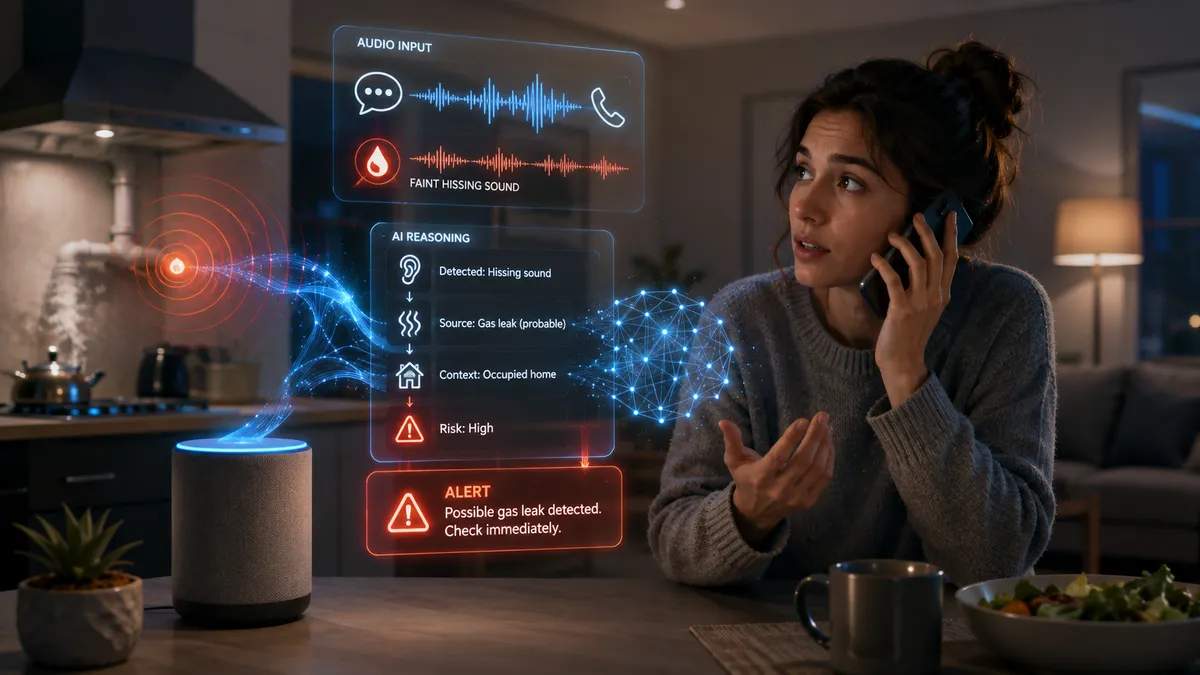
Beyond Transcription: How New AI Models Are Learning Not Just What We Say, But What It Means
Imagine a smart home speaker that can hear a faint hiss of gas leaking through your pipes while you are talking on the phone about dinner plans. Instead of simply logging your words as separate events, it understands the relationship between them — recognizing danger in context and alerting you before you even notice.
That is the kind of leap forward engineers at X3-OPD have made possible with a new approach to training artificial intelligence models that process audio. The research, published on arXiv under the title "X3-OPD: Distilling Reasoning into Large Audio-Language Models via On-Policy Alignment," was led by Dongjie Fu and his colleagues at Zhejiang University in China.
Why Audio AI Still Struggles With Logic
Large audio-language models have made remarkable progress in understanding speech and sound over the past few years. They can transcribe conversations, identify speakers, and even detect environmental sounds with increasing accuracy. Yet these systems lag far behind text-based large language models when it comes to deep logical reasoning.
The bottleneck is one of data. Most audio-language models are trained on raw recordings — phone calls, music, ambient noise — but rarely are they given the kind of structured reasoning problems that drive sophisticated AI assistants in text. Without high-quality examples of how to reason from sound, these models learn only surface-level patterns rather than genuine understanding.
A Teacher and a Student Working Together
To bridge this gap, the research team built X3-OPD, a framework that uses cross-modal on-policy distillation to transfer reasoning capabilities from a powerful text-based model — called the teacher — into an audio-language student model. The method works by having the student generate its own chain-of-thought reasoning while it processes sound inputs, then receiving token-level guidance from the teacher using matched textual versions of the same problems.
This approach is different from earlier methods that simply fed pre-written answers to models during training. Instead, the team designed a three-tier corpus that covers several distinct types of audio-grounded reasoning tasks. The first tier involves taking written logical steps and having them spoken aloud so the student model learns to follow reasoning chains directly in audio form.
The second tier focuses on audio-event reasoning grounded in complex acoustic scenes — for example, distinguishing between an alarm triggered by a fire versus one caused by routine maintenance machinery running nearby. Here, the AI must reason about what is happening based on layered sound rather than just matching words to meanings.
The third tier involves spoken-dialogue reasoning, which includes paralinguistic cues such as tone of voice, pitch changes, and emotional context. This allows the student model to understand not only what people are saying but also how they are feeling — whether someone is frustrated, excited, or uncertain during a conversation.
Extending Reasoning Beyond Words
What makes this framework particularly powerful is that it extends cross-modal distillation beyond content that could be fully recovered as text. In many earlier approaches, the audio was simply transcribed and then treated like regular writing for training purposes. X3-OPD goes further by also transferring reasoning patterns grounded in non-linguistic events, prosody, and conversational context.
This matters because real-world audio is rarely just speech. A smart home system must understand the difference between your voice and a doorbell. An industrial safety monitor must detect not only that something sounds wrong but why it sounds wrong based on surrounding conditions. Without reasoning grounded in these additional signals, AI systems remain limited to recognizing words rather than truly comprehending situations.
Proven Gains Across Multiple Benchmarks
The team tested their approach across several standard audio-language benchmarks including MMSU for speech understanding, MMAU for multilingual audio tasks, BIG-Bench Audio for complex reasoning challenges, and MMAR for multi-modal audio retrieval. Results showed that X3-OPD substantially improved both audio-grounded reasoning and the quality of chain-of-thought outputs.
Importantly, the model maintained its existing capabilities even when tested on different types of audio inputs — a property known as domain robustness. The approach did not sacrifice performance in areas where the student model was already strong, which means it can be deployed without risking regression in other tasks.
Looking Ahead for Practical Applications
The implications stretch well beyond academic benchmarks. Voice assistants could move past simple command recognition to genuinely understand what a user needs based on context and tone. Industrial safety systems would not only detect unusual sounds like equipment failures but reason about whether those sounds match known failure patterns in specific environments.
Healthcare monitoring devices might listen to patients' voices during consultations and reason through symptoms described alongside emotional cues, potentially catching conditions that simple transcription misses. Autonomous vehicles could interpret a pedestrian's alarmed shout differently from casual conversation by reasoning about urgency and context together.
The research was supported by Zhejiang University in China and published on arXiv, where it remains accessible to the broader scientific community for further development and integration into next-generation audio-language systems.
Read the paper here:
http://arxiv.org/abs/2607.21550v1Comments (0)
Related News
AI Now Learns to Reason From Sound: New Framework Lets Voice Assistants Understand Context, Not Just Words
Researchers have developed a system that teaches audio-focused artificial intelligence models not just to recognize speech but to perform complex logical reasoning by transferring advanced skills from text-based models — opening the door for voice assistants, industrial safety systems and healthcare monitoring to understand what we mean rather than only what we say.

High-Dose Flu Shots Cut Hospital Visits for Seniors, But Do Not Reduce Risk of Death
A landmark analysis of nearly 600,000 older adults finds that high-dose flu vaccines significantly reduce hospitalizations but show no clear benefit in preventing death — a distinction that could reshape how public health officials recommend seasonal vaccinations.

From Text to Total Immersion: AI System Builds Physically Accurate Virtual Worlds From a Single Sentence
A multi-agent system from UMass Amherst turns natural language descriptions into four-dimensional virtual worlds that obey real physics, opening new possibilities for film, gaming and robotics.
Stay ahead of the science.
Weekly research news digest, translated for curious minds.