From Text to Total Immersion: AI System Builds Physically Accurate Virtual Worlds From a Single Sentence
A multi-agent system from UMass Amherst turns natural language descriptions into four-dimensional virtual worlds that obey real physics, opening new possibilities for film, gaming and robotics.

A Single Sentence, a Fully Realistic World
Type a sentence describing a scene-coffee spilling onto a table, curtains fluttering in an imagined breeze-and watch a complete environment spring to life before your eyes. That is exactly what GS-Agent has accomplished, and it represents one of the most significant leaps forward for creative industries since 3D modeling tools first hit the market.
The Problem with Today's Tools
Traditional computer graphics pipelines have always relied on human artists to build every element of a scene by hand. Materials need fine-tuning, objects must be positioned carefully, and lighting is adjusted one parameter at a time. The process is painstaking and expensive, scaling poorly as projects grow in complexity.
Recent advances in generative foundation models have offered hope for automating this work. Large-scale AI systems can now produce images and videos from text prompts with remarkable speed. Yet existing approaches still struggle to ensure physical plausibility-objects float when they should fall, liquids do not splash correctly, and collisions often look wrong.
The core challenge remains: how do you create a world that not only looks good but also behaves according to the laws of physics?
An Agentic Architecture That Mirrors Human Collaboration
Rather than forcing a single generative model to handle everything at once, the researchers at UMass Amherst took a different path. They designed GS-Agent as an end-to-end multi-agent framework that integrates physics engines directly into the creative loop.
The system was inspired by how human teams traditionally build virtual worlds. In film production, artists work in distinct roles: one person curates 3D assets and decides what objects to use, another tunes materials like wood or glass, a third figures out where everything goes in space, and yet another controls motion and animation. Camera operators and lighting designers handle rendering configuration separately.
GS-Agent decomposes the task into these same logical categories but automates them entirely through specialized AI agents that each possess distinct expertise. These agents interact with a physics engine via code, seek multimodal feedback when something looks off, and collaborate to iteratively construct worlds that align with their given descriptions.
The multi-agent architecture means the system can handle complexity in a structured way rather than relying on one massive model to do everything at once. Each agent focuses on its specialty—whether placing objects correctly so they will not clip through each other or adjusting lighting to create cinematic mood—and the physics engine provides ground-truth validation throughout the process.
What the Experiments Showed
Experimental results demonstrate that GS-Agent effectively converts natural language into diverse and physically plausible four-dimensional worlds. The generated scenes exhibit rich interactions among liquids, deformable objects like cloth and rubber, and rigid bodies such as furniture and machinery.
Camera angles and lighting can be controlled cinematically to match the tone of any scene, a feature that is especially valuable for filmmakers and game developers who need precise visual control without pre-visualization pipelines. The system also serves as a foundation for training physical AI systems in complex virtual environments—researchers can build worlds that simulate real-world conditions and use those simulations to teach robots how to interact with the physical world safely before deploying them anywhere.
What Comes Next
The GS-Agent project is hosted on a public website maintained by the UMass Embodied AGI research group. The team envisions this work as just the beginning of a new paradigm in four-dimensional world generation that empowers both creative content creation and physical AI research.
As foundation models continue to improve, the multi-agent approach used here may prove more robust than single-model architectures for tasks requiring both generative creativity and physical fidelity. The integration of physics engines into the loop is particularly promising because it provides a hard constraint against which generated worlds can be validated rather than guessed at by neural networks alone.
The full details of GS-Agent, including code and demonstrations, are available through the project page maintained by the UMass Amherst researchers who developed the system. For those interested in exploring the technology further, you can find it at umass-embodied-agi.github.io/gs-agent/.
Read the paper here:
http://arxiv.org/abs/2607.21522v1Comments (0)
Related News
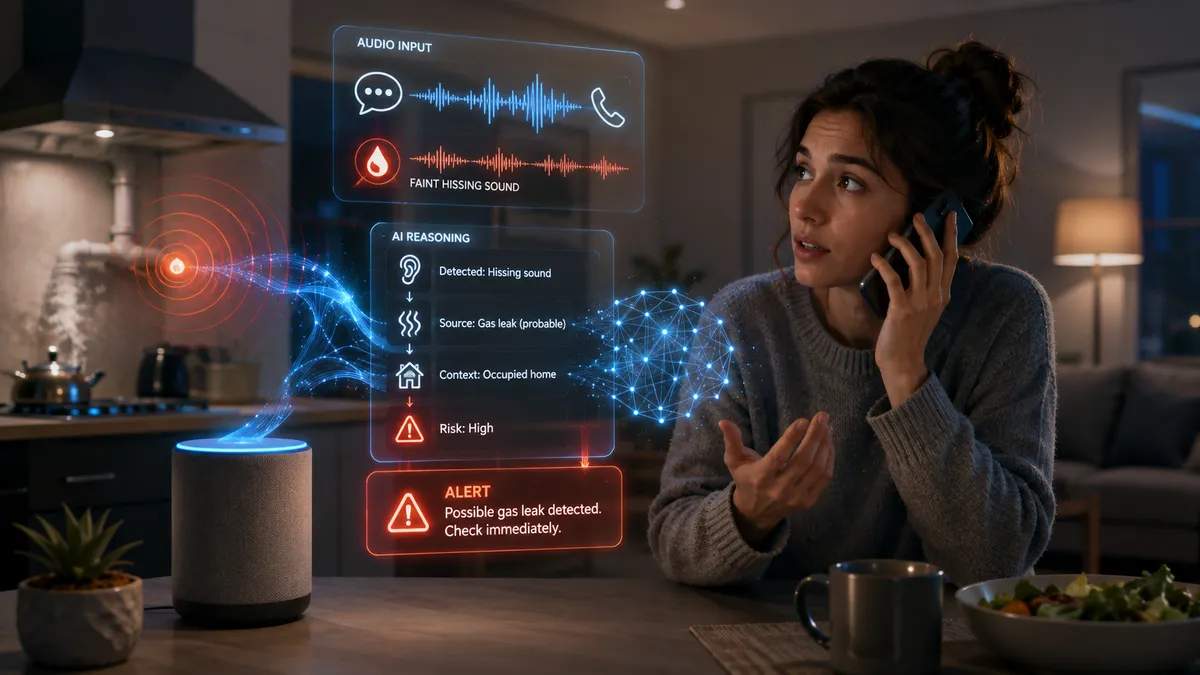
AI Now Learns to Reason From Sound: New Framework Lets Voice Assistants Understand Context, Not Just Words
Researchers have developed a system that teaches audio-focused artificial intelligence models not just to recognize speech but to perform complex logical reasoning by transferring advanced skills from text-based models — opening the door for voice assistants, industrial safety systems and healthcare monitoring to understand what we mean rather than only what we say.

High-Dose Flu Shots Cut Hospital Visits for Seniors, But Do Not Reduce Risk of Death
A landmark analysis of nearly 600,000 older adults finds that high-dose flu vaccines significantly reduce hospitalizations but show no clear benefit in preventing death — a distinction that could reshape how public health officials recommend seasonal vaccinations.
From Text to Total Immersion: AI System Builds Physically Accurate Virtual Worlds From a Single Sentence
A multi-agent system from UMass Amherst turns natural language descriptions into four-dimensional virtual worlds that obey real physics, opening new possibilities for film, gaming and robotics.
Stay ahead of the science.
Weekly research news digest, translated for curious minds.