Beyond Static Data: How AI Models Predict from Continuous Streams
Traditional AI models often fail when data arrives in real-time. New statistical techniques, centered on Gaussian Processes, allow machines to process continuous data streams, making real-time forecasting and decision-making possible.
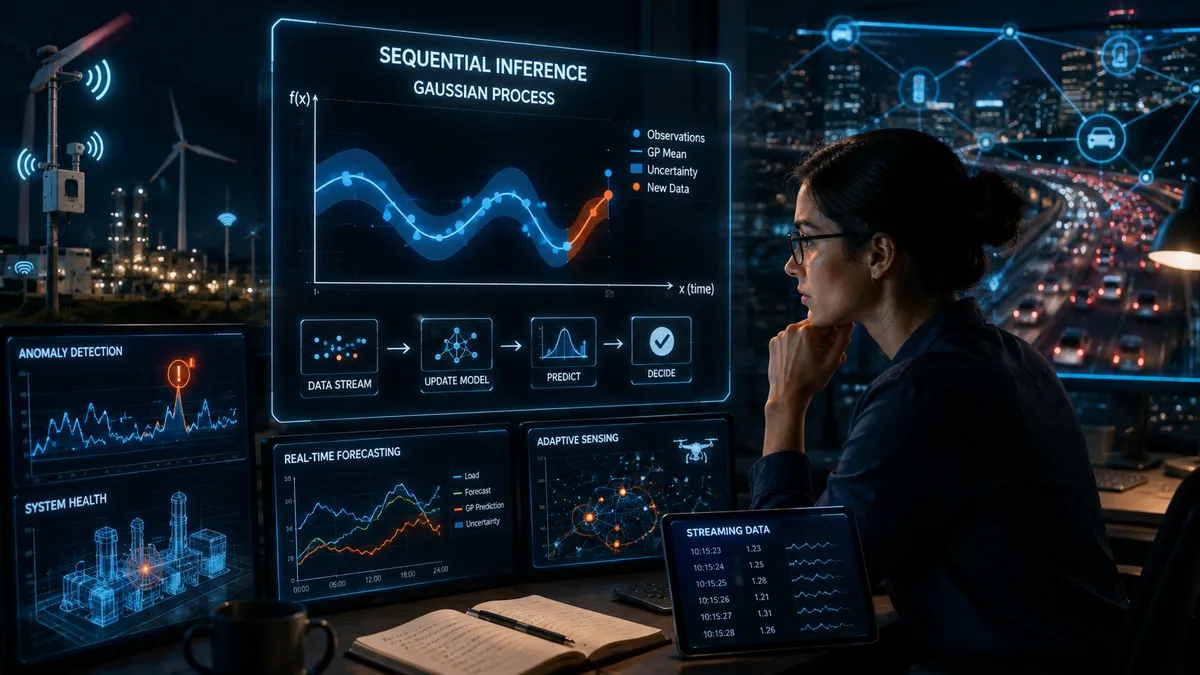
As the volume of data generated by the Internet of Things (IoT) and advanced sensors explodes, the ability of artificial intelligence to process information in real-time has become the defining challenge. Traditional machine learning models often require entire datasets to be gathered before they can make predictions, rendering them obsolete in fast-moving, continuous systems. However, a recent review of advanced statistical methods reveals a critical breakthrough: sequential inference. This technique allows sophisticated models to learn and make accurate predictions as data arrives, transforming how we build systems that require instantaneous decision-making.
At the heart of this advancement are Gaussian Processes (GPs). GPs are powerful, flexible statistical frameworks used to model random functions—meaning they can map complex, non-linear relationships in data that simple straight lines or curves cannot capture. They provide a robust way for AI to predict not just a single output, but a probability distribution of possible outcomes. When paired with sequential inference, GPs can continuously update their understanding of the system with every new data point, rather than needing a complete picture from the outset.
The Shift to Real-Time Learning
The core innovation detailed by researchers is the shift from 'batch processing' (waiting for all data) to 'streaming inference.' This is vital for any system operating in the physical world—whether it's predicting traffic flow, monitoring structural integrity, or optimizing a financial portfolio. Instead of being limited to historical analysis, these updated models can actively participate in the process, adjusting their predictions moment by moment. This capability moves AI from being a retrospective analysis tool to a truly adaptive, proactive decision-making engine.
Practical Applications of Streaming AI
This methodological shift has sweeping real-world implications. For instance, in anomaly detection, a streaming GP can identify unusual spikes or dips in sensor readings immediately, signaling potential equipment failure before it becomes catastrophic. In forecasting, it allows energy grids or supply chains to dynamically adjust predictions based on real-time usage patterns. Furthermore, in fields like adaptive sensing, it enables systems to continuously optimize their own performance by learning from the continuous flow of feedback.
The review provides a practical roadmap for engineers and data scientists, outlining how to implement these complex mathematical concepts into robust, working systems. By making the principles of sequential Bayesian modeling more accessible, the research accelerates the adoption of these powerful tools across critical infrastructure.
This move toward continuous, adaptive intelligence represents a fundamental change in signal processing, enabling a new generation of AI systems that are not just smart, but constantly aware of their changing environment. The study was published in arXiv.
Read the paper here:
http://arxiv.org/abs/2604.28163v1Comments (0)
Related News
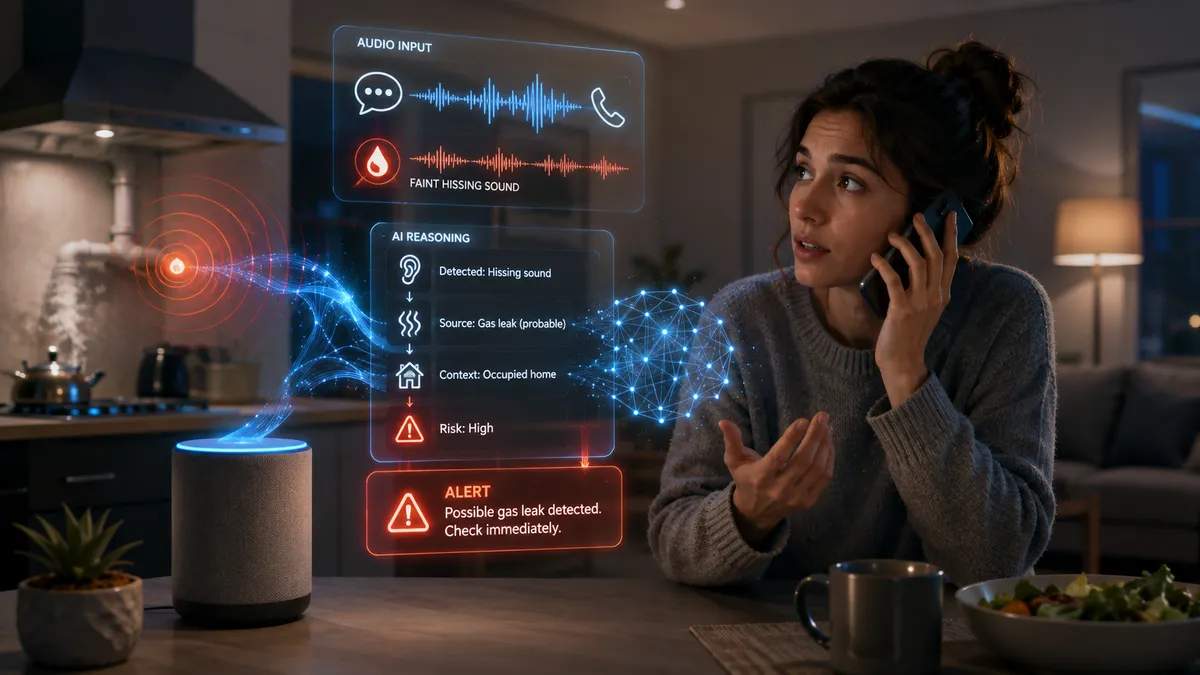
AI Now Learns to Reason From Sound: New Framework Lets Voice Assistants Understand Context, Not Just Words
Researchers have developed a system that teaches audio-focused artificial intelligence models not just to recognize speech but to perform complex logical reasoning by transferring advanced skills from text-based models — opening the door for voice assistants, industrial safety systems and healthcare monitoring to understand what we mean rather than only what we say.

High-Dose Flu Shots Cut Hospital Visits for Seniors, But Do Not Reduce Risk of Death
A landmark analysis of nearly 600,000 older adults finds that high-dose flu vaccines significantly reduce hospitalizations but show no clear benefit in preventing death — a distinction that could reshape how public health officials recommend seasonal vaccinations.

From Text to Total Immersion: AI System Builds Physically Accurate Virtual Worlds From a Single Sentence
A multi-agent system from UMass Amherst turns natural language descriptions into four-dimensional virtual worlds that obey real physics, opening new possibilities for film, gaming and robotics.
Stay ahead of the science.
Weekly research news digest, translated for curious minds.