Researchers Build Synthetic Digital Worlds to Train AI Agents for Months-Long Professional Work
A new method generates thousands of simulated computer environments populated with realistic documents and file structures, enabling AI agents to practice complex professional tasks that span weeks or months before ever interacting with real users.
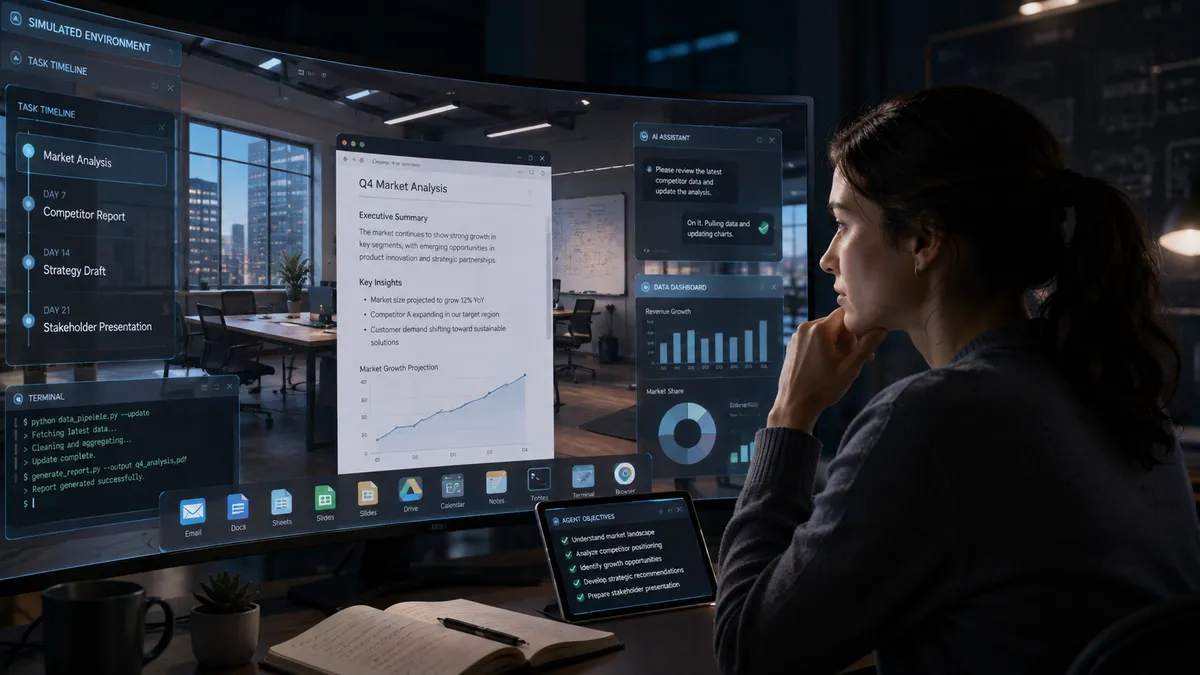
Training an artificial intelligence system to perform genuine professional labor — navigating file structures, collaborating with colleagues, and completing projects over the span of weeks — requires a training ground that matches the complexity of real work. For years, AI research has relied on static datasets and simple question-and-answer exchanges that fall far short of capturing how knowledge workers actually operate. A team led by Tao Ge, Baolin Peng, Hao Cheng, and Jianfeng Gao has built a solution that addresses this gap directly.
Their work, published as "Synthetic Computers at Scale" on arXiv in April 2026, introduces a methodology for creating simulated digital environments where AI agents can practice long-horizon productivity workflows before encountering real users. The approach starts with generating synthetic computer setups — complete with realistic folder hierarchies and content-rich artifacts like documents, spreadsheets, and presentations — then running multi-agent simulations on those environments to produce rich experiential learning signals.
The core challenge driving this research is the disconnect between how AI agents are currently trained and what they need to do in production. Most productivity tasks require sustained context across time: a project manager might spend weeks coordinating deliverables, iterating through drafts, and adjusting plans based on feedback from teammates. Existing training paradigms cannot replicate that kind of depth because real-world user data is both private and expensive to collect at scale. The researchers recognized that scalable synthetic computer creation, paired with long-horizon simulations, offers a promising path forward.
To build these synthetic environments, the team developed a two-stage process. First, they create realistic folder hierarchies populated with content-rich artifacts — things like Word documents, Excel spreadsheets, and PowerPoint presentations — that reflect how actual users organize their work. Then they run long-horizon simulations conditioned on each synthetic computer: one agent creates productivity objectives specific to the simulated user's profession and role, requiring multiple professional deliverables spanning roughly a month of human effort. A second agent then acts as that user, navigating the filesystem for grounding, coordinating with simulated collaborators, and producing artifacts until the objectives are completed.
In preliminary experiments, the team created 1,000 synthetic computers and ran long-horizon simulations on each one. Every run required more than eight hours of continuous agent runtime and averaged over 2,000 turns — a single simulation mimicking months of professional activity compressed into computational time. These simulations produced rich experiential learning signals whose effectiveness was validated by significant improvements in agent performance across both in-domain and out-of-domain productivity evaluations.
The implications for training truly autonomous AI agents are substantial. Because realistic personas exist at billion-scale abundance, this methodology can scale to millions or even billions of synthetic user worlds given sufficient compute. That scalability opens the door to broader coverage of diverse professions, roles, contexts, environments, and productivity needs — essentially allowing researchers to simulate entire career trajectories across countless industries without ever collecting private data.
"Given that personas are abundant at billion scale, this methodology can in principle scale to millions or even billions of synthetic user worlds with sufficient compute," the authors note. "This enables broader coverage of diverse professions, roles, contexts, environments, and productivity needs." They argue that scalable synthetic computer creation, together with at-scale simulations, is highly promising as a foundational substrate for agent self-improvement and agentic reinforcement learning in long-horizon productivity scenarios.
The paper builds on earlier work by the same group, including previous research on scaling productivity agents through iterative training frameworks. Their approach represents a shift from reactive AI — systems that answer questions or perform single-step tasks — toward proactive agents capable of sustained engagement across complex workflows. The team acknowledges that significant computational resources are required to run these extended simulations, but they position synthetic computer creation as an investment that pays dividends by enabling self-improvement loops where agents learn continuously rather than from frozen datasets.
Looking ahead, the researchers see this work as laying groundwork for next-generation agentic systems. If early experiments with 1,000 synthetic computers can already demonstrate measurable gains in agent performance across multiple evaluation benchmarks, scaling to millions of simulated environments could accelerate the development of AI assistants that handle months-long projects with genuine autonomy. The team plans to share their methodology and synthetic computer datasets openly to enable broader research into long-horizon productivity simulation.
The study was published on arXiv as part of ongoing work by researchers at institutions including Google and its parent organization Alphabet. It contributes to a growing body of research exploring how foundational AI capabilities can be developed through scalable synthetic data generation rather than traditional supervised learning approaches.
Read the paper here:
http://arxiv.org/abs/2604.28181v1Comments (0)
Related News
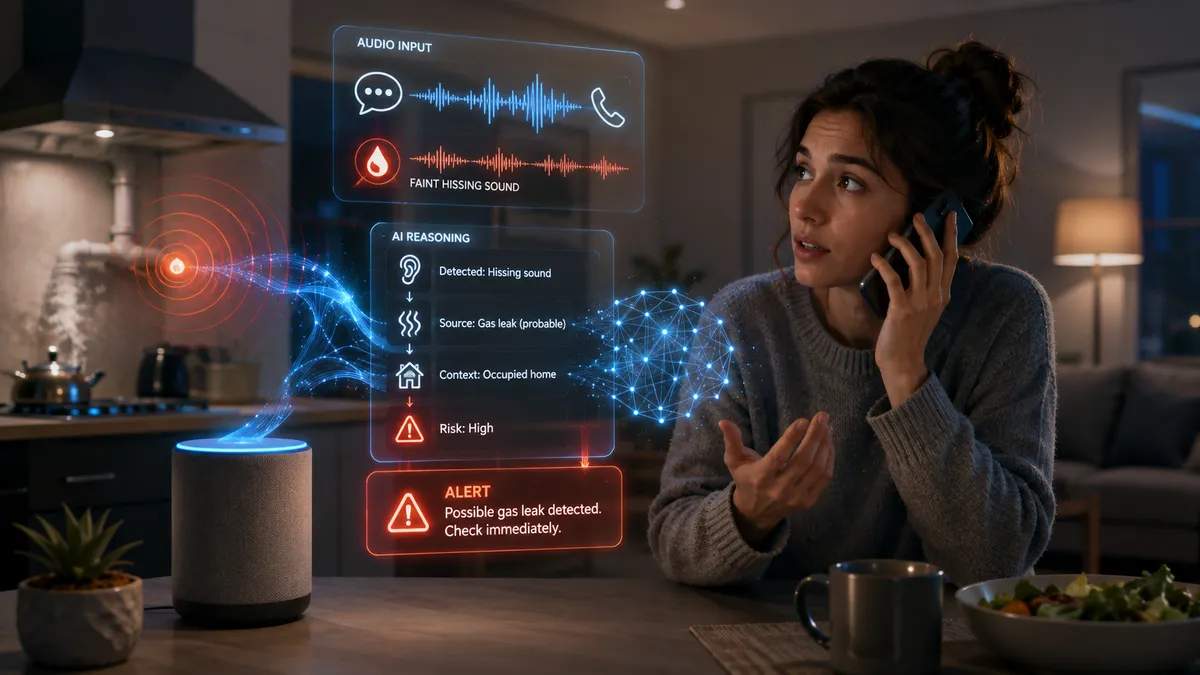
AI Now Learns to Reason From Sound: New Framework Lets Voice Assistants Understand Context, Not Just Words
Researchers have developed a system that teaches audio-focused artificial intelligence models not just to recognize speech but to perform complex logical reasoning by transferring advanced skills from text-based models — opening the door for voice assistants, industrial safety systems and healthcare monitoring to understand what we mean rather than only what we say.

High-Dose Flu Shots Cut Hospital Visits for Seniors, But Do Not Reduce Risk of Death
A landmark analysis of nearly 600,000 older adults finds that high-dose flu vaccines significantly reduce hospitalizations but show no clear benefit in preventing death — a distinction that could reshape how public health officials recommend seasonal vaccinations.

From Text to Total Immersion: AI System Builds Physically Accurate Virtual Worlds From a Single Sentence
A multi-agent system from UMass Amherst turns natural language descriptions into four-dimensional virtual worlds that obey real physics, opening new possibilities for film, gaming and robotics.
Stay ahead of the science.
Weekly research news digest, translated for curious minds.