The Heart Has a Secret Life: Why Medical Students Should Learn About Hormones Before They Study the Pump
Scientists are urging medical schools to teach that the heart is more than a pump, revealing its hidden role as an endocrine organ that releases hormones and signals stress long before a diagnosis of failure.
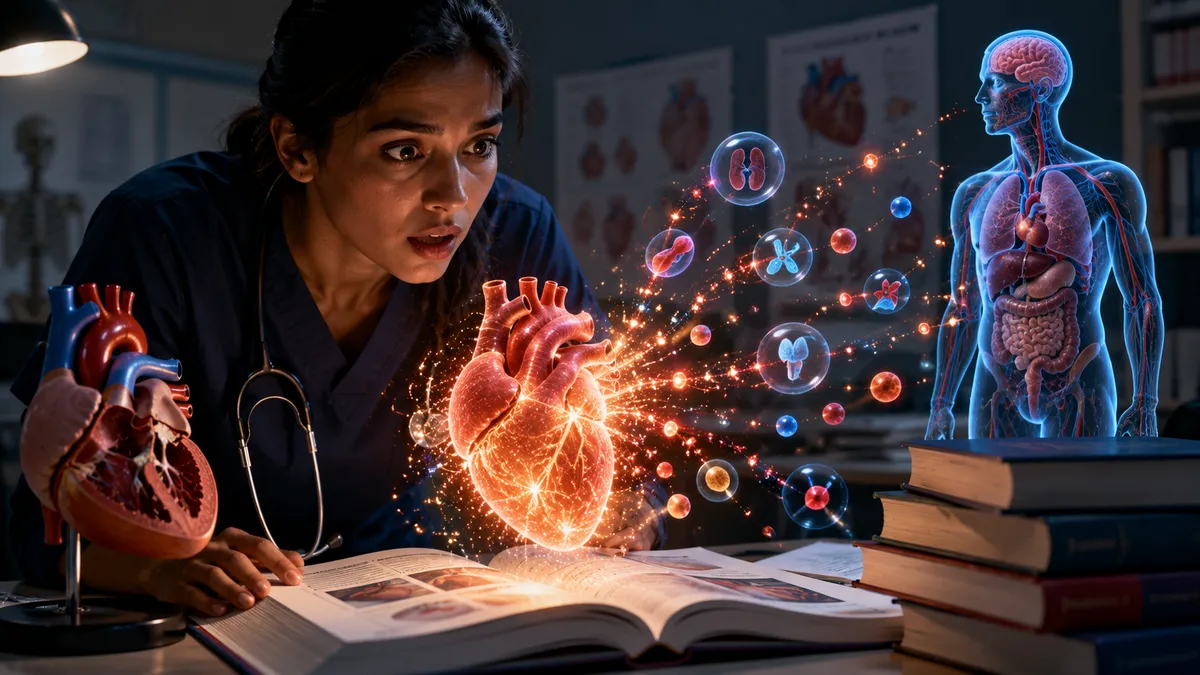
The Heart's Hidden Chemical Identity
For decades, doctors have taught that the heart works like a mechanical pump. It squeezes blood through vessels and keeps oxygen circulating. But a new framework from researchers at several universities argues that this view is incomplete.
The truth, they say, is far more fascinating. The heart also acts as an endocrine organ, releasing natural chemical messengers directly into the bloodstream. These hormones do not merely signal trouble. They actively regulate fluid balance and warn clinicians when a patient is struggling before damage becomes visible on imaging or in lab tests.
Why This Matters for Medical Training
The researchers behind this proposal argue that medical education should move beyond traditional anatomy lessons focused on heart valves, chambers, and muscle contractions. Instead, they say future doctors need to understand how the organ functions as part of a broader chemical communication system within the body.
This is not just an academic exercise. Understanding these hormonal signals gives clinicians better tools for diagnosing complex conditions like fluid imbalances and various forms of heart failure early in their progression. When students learn that the heart speaks chemically, they also begin to see organs as connected systems rather than isolated parts.
The Key Hormones at Play
Among the most important substances released by the heart are two natural peptides known as ANP and BNP. These molecules are produced inside heart cells in response to stretching or stress. When blood pressure rises or when fluid builds up around the heart, these peptides flood into circulation.
They act like built-in warning alarms. Their presence tells the body to release sodium and water while signaling kidneys to filter more blood. For doctors, detecting elevated levels of ANP or BNP in a patient can mean catching heart failure at an earlier stage than traditional methods allow.
A Framework for Change
The researchers conducted a comprehensive review of existing scientific literature and educational principles to develop this new teaching model. They examined how cardiac endocrine function could be woven into standard medical school lessons without displacing other essential content.
Their approach emphasizes early integration rather than waiting until advanced electives or graduate-level courses. The goal is simple: if students understand the heart as a communicating organ from day one, they will carry that perspective throughout their careers and adapt it to any clinical situation.
Looking Ahead
If medical schools adopt this framework broadly, the ripple effects could reshape how cardiovascular health is understood by future generations of healthcare providers. Patients with subtle symptoms would benefit from doctors who know what to look for. And the foundation for personalized medicine based on hormonal biomarkers would be stronger than ever.
The researchers note that while their proposal addresses early education, it can also be adapted for continuing professional development. Even practicing cardiologists could revisit these concepts when training the next generation of nurses and technicians.
How to Support This Work
This research was supported by contributions from multiple institutions and reviewed through peer-reviewed academic channels. The team includes scholars from medical schools across continents, reflecting a growing global interest in how modern cardiovascular science must evolve alongside traditional teaching methods.
Read the paper here:
doi: 10.1080/10872981.2026.2704285Comments (0)
Related News

AI Now Learns to Reason From Sound: New Framework Lets Voice Assistants Understand Context, Not Just Words
Researchers have developed a system that teaches audio-focused artificial intelligence models not just to recognize speech but to perform complex logical reasoning by transferring advanced skills from text-based models — opening the door for voice assistants, industrial safety systems and healthcare monitoring to understand what we mean rather than only what we say.

High-Dose Flu Shots Cut Hospital Visits for Seniors, But Do Not Reduce Risk of Death
A landmark analysis of nearly 600,000 older adults finds that high-dose flu vaccines significantly reduce hospitalizations but show no clear benefit in preventing death — a distinction that could reshape how public health officials recommend seasonal vaccinations.

From Text to Total Immersion: AI System Builds Physically Accurate Virtual Worlds From a Single Sentence
A multi-agent system from UMass Amherst turns natural language descriptions into four-dimensional virtual worlds that obey real physics, opening new possibilities for film, gaming and robotics.
Stay ahead of the science.
Weekly research news digest, translated for curious minds.